


Screed Drying Times & Measuring Moisture Content
Posted by Pure Adhesion Ltd on 26th May 2026
Moisture testing in screeds is mainly about answering one question:
“Is the floor dry enough for the next layer to go on safely?”
That next layer might be tiles, vinyl, timber, resin, carpet, or a waterproof membrane. If the screed is still too wet, finishes can fail — adhesives break down, timber warps, vinyl bubbles, and mould can develop.
Here are the main methods used on site, explained simply.
- Hygrometer Test (Relative Humidity / RH Test)
This is the most common and most trusted method in the UK for floor finishes.
How it works
A sealed box or probe is placed on or into the screed. It measures the humidity trapped in the screed.
The wetter the screed, the higher the RH reading.
Typical interpretation
- 75% RH or below
- Usually acceptable for most floor finishes
- 65% RH or below
- Often required for sensitive finishes like timber or some vinyl systems
- Above 75% RH
- Generally considered too wet
Why people use it
- Non-destructive or minimally invasive
- Recognised in British Standards
- Gives a realistic picture of moisture that could affect adhesives
Important point
RH testing measures moisture equilibrium, not just surface dryness.
A screed can look dry on top but still fail an RH test.
- Carbide Bomb / CM Test
Common in Europe and sometimes used for fast-track projects.
How it works
A sample of screed is crushed and mixed with calcium carbide in a sealed pressure vessel.
Moisture reacts and creates gas pressure.
More pressure = more moisture.
Interpretation
Results are given as percentage moisture content by weight.
Typical targets:
- Cement screed: around ≤2.0% CM
- Calcium sulphate/anhydrite screed: often ≤0.5% CM
(Exact limits depend on manufacturer requirements.)
Advantages
- Very accurate
- Measures actual internal moisture
- Fast result
Downsides
- Destructive
- Requires taking samples
- Needs trained operator
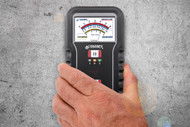
- Electrical Resistance Meter
Often called a “moisture meter.”
How it works
Pins or sensors measure electrical resistance.
Wet screeds conduct electricity differently from dry screeds.
Interpretation
This method is mainly:
- comparative
- indicative
- for surveys
It is not usually accepted alone for sign-off of floor finishes.
Best use
- Finding wet areas quickly
- Comparing one area to another
- Preliminary checks before RH testing
Important limitation
Different screed types give different readings.
A reading of “3%” on a handheld meter usually does not mean true 3% moisture content.
- Oven-Dry Test
The laboratory reference method.
How it works
- A screed sample is weighed
- It is dried completely in an oven
- It is weighed again
The weight loss equals water content.
Interpretation
Produces true gravimetric moisture content.
Advantages
- Very accurate
- Useful for disputes or research
Downsides
- Slow
- Destructive
- Usually laboratory-based
Not common for routine site decisions.
- In-Situ Probe Testing
Similar to RH testing but uses drilled probes inserted into the screed depth.
Why it matters
Surface testing can miss deeper moisture.
Probe testing checks what is happening inside the screed.
This is especially useful for:
- thick screeds
- fast-drying screeds
- heated screeds
- suspicious readings
The Most Important Thing: Know What You’re Measuring
Different tests measure different things.
|
Test |
Measures |
Best For |
|
RH Hygrometer |
Humidity equilibrium |
Floor finish acceptance |
|
CM Test |
Actual moisture by weight |
Fast-track verification |
|
Resistance Meter |
Electrical response |
Surveys and screening |
|
Oven-Dry |
True water content |
Laboratory accuracy |
|
Probe RH |
Internal humidity |
Thick screeds |
Why Screed Type Matters
Different screeds behave differently.
Cement:sand screeds
- Dry relatively predictably
- Often assessed at 75% RH
Calcium sulphate / anhydrite screeds
- Very sensitive to moisture
- Often require lower moisture limits
- Surface laitance must also be removed
Fast-drying screeds
- Can reach acceptable RH much earlier
- Must follow manufacturer guidance, not assumptions
Surface Dry ≠ Fully Dry
One of the biggest misunderstandings on site.
A screed can:
- feel hard,
- look pale,
- be walkable,
…while still holding large amounts of moisture deeper down.
That moisture later migrates upward and damages finishes.
This is why standards rely on RH or equivalent internal testing.
Typical UK Guidance
In the UK, testing is commonly aligned with:
- British Standards Institution guidance
- BS 8203 (resilient flooring)
- BS 5325 (textile flooring)
- BS 8201 (wood flooring)
Most specifications ultimately defer to:
- floor finish manufacturer requirements
- adhesive manufacturer limits
- screed manufacturer guidance
If those conflict, the strictest requirement normally governs.
Practical Site Approach
A sensible workflow is usually:
- Use a moisture meter for quick screening
- Identify suspect/wet areas
- Carry out RH testing properly
- Compare against floor finish requirements
- Record temperature and ambient conditions
- Retest if drying conditions change
Common Mistakes
Testing too early
Fresh screeds can give misleading readings.
Testing only near doors/windows
These dry faster than the middle of rooms.
Ignoring heating history
Underfloor heating dramatically affects readings.
Not sealing RH boxes properly
This can invalidate results.
Assuming all finishes use 75% RH
Many modern adhesives require lower values.
Simple Rule of Thumb
- Moisture meter = quick indication
- RH test = main acceptance test
- CM test = highly accurate spot verification
- Oven-dry = laboratory truth
And the final question is always:
“Is it dry enough for this specific floor system?”

