


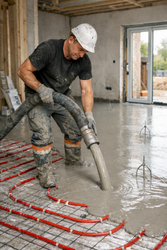
When Can You? or Should You Ever Tile onto a “Green” Screed?
Posted by Pure Adhesion Ltd on 17th Feb 2026
Tiling on a "green" (newly laid) screed is possible, but it comes with significant risks of tile de-bonding or cracking if not done correctly. Green screed is considered "green" from the time it is applied until it gains sufficient strength and reaches stability, which can take weeks.
Here is a comprehensive guide to when you should (and should not) do it, along with the required installation steps.
Part 1: Should You Tile on Green Screed?
Generally, you should avoid it if possible. The best practice is to wait until the screed is fully cured (usually at least 28 days) and has reached a moisture content below 75% relative humidity (RH).
Risks of premature tiling:
- Tile "Blowing": As the screed dries, it shrinks. If tiles are locked down too soon, the shrinkage can cause them to lift or pop off (heave).
- Adhesive Failure: Trapped moisture can weaken the bond between the adhesive and the screed.
- Efflorescence: Moisture forcing salts up through grout joints.
Part 2: Guide to Tiling on Green Screed
If you must proceed with tiling a new screed, follow these steps to minimize risk.
- Assess and Prepare the Substrate
- Wait Time: Ideally, wait 1 day per 1mm of thickness for sand/cement screeds (up to 40mm). Thereafter 1mm every 2 days.
- Laitance Removal: 4-6 days after application, remove the weak, dusty surface layer (laitance) using a floor sander or scarifier.
- Moisture Testing: Use a hygrometer to check that the moisture content is safe (typically <75% RH).
- Clean: Vacuum the surface thoroughly to remove all dust.
- Priming (Crucial Step)
- Cement-based Screed: Prime with a suitable primer to control porosity.
- Anhydrite/Liquid Screed: You must seal anhydrite screeds with a compatible acrylic primer to prevent a chemical reaction (ettringite formation) between the gypsum and cement-based adhesive.
- Select Materials
- Adhesive: Use a high-quality flexible adhesive (S1 or S2 classification). Specialized rapid-set, flexible adhesives are recommended for "green" applications.
- Decoupling Matting: For high-risk or very new screeds, install a crack-isolation/decoupling mat to bridge potential cracks.
- Grout: Use a flexible, waterproof, and hardwearing grout.
- Laying the Tiles
- Solid Bed: Apply the adhesive using a solid bed method to ensure 100% coverage, preventing voids.
- Movement Joints: Ensure perimeter expansion gaps are left at all walls and structural joints.
Summary Checklist
|
Step |
Action |
|
Wait |
Ideal is 1mm per day unless a rapid drying screed has been used. |
|
Remove |
Sand off "laitance" (white, powdery layer). |
|
Clean |
Vacuum thoroughly. |
|
Prime |
Use proper, non-PVA primer. |
|
Bond |
Use flexible S1/S2 adhesive & decoupling mat. |
|
Seal |
Use flexible, polymer-modified grout. |
Disclaimer: Always follow the specific, written instructions from the adhesive manufacturer regarding their compatibility with green/fresh screeds.

